
Advisory Role: Maximizing Potential

Tachles Series: Benzi Ronen shares insight, anecdotes, and expert hacks for Israeli entrepreneurs looking to grow their business in the US.

Find out how to:
Understand what the role of an advisor is.
Decide if you need one, and select the best advisor for your needs.
Determine appropriate compensation for an advisor
Nu, get to the point:
A good advisor can help founders accelerate the success of their startup. Even if an advisor helps improve performance by just 5%, compounded month over month that can amount to a significant uptick in the overall trajectory of the business.
In order to make an effective impact, an advisor needs to have a strong relationship with the founders, be involved in the week-to-week of the business and set out clear expectations. The last piece is often overlooked, but key. I was recently advising a startup where my role hadn’t been defined — an amateur mistake on my part, which led to miscommunication and disappointment.
The CEO was looking to hold me accountable to quarterly deliverables, a best practice that generally leads to good results with consultants or employees. However, advisors are more like coaches — their impact is measured by how much they can improve the performance of others (in this case, the founders and leadership team).
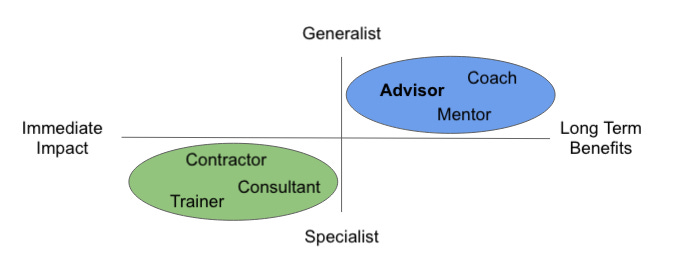
At my first two startups, my advisor was able to help me avoid mistakes and grow as a CEO — and they were invaluable when things weren’t going well. An advisor is on your speed dial when shit gets hard, when you’re lonely, and scared, and don’t know what to do. They’re in your foxhole.
If you’re a founder or CEO considering bringing on an advisor, you’ll need to know how they can assist you, how to find the right person, and how to work together; I’ve put together a few hacks to help you do just that.
Hacks
How do I know if I would benefit from an advisor?
A good advisor empowers people to materialize the best versions of themselves, thereby indirectly fine-tuning a startup’s strategy and execution. Ask yourself the following questions:
Do I need help to refine my overall business strategy and operational plan?
Could I use help to develop the narrative of the startup and its value proposition?
Am I looking for someone to challenge my decisions and assumptions (thought partner)?
Could I use someone to make introductions to a wider network?
Would an outside perspective help me to not make mistakes?
Am I trying to improve my individual performance as a leader?
If you answered “yes” to at least two of them, an advisor may be just what you need.
How do I find the right fit?
Picking a good advisor comes down to five things: chemistry, loyalty, experience, vulnerability, and a lack of ego. More specifically, you should look for someone:
...who you have a good relationship with, respect, believe in, and enjoy talking to.
...without any conflicting interests, who you can always trust to have your back.
...with a proven track record of leading companies through growth phases, building and scaling management teams, fundraising, and board management.
...who can be open and straightforward, even if it’s to share doubts or concerns.
...that’s happy taking a backseat; advisors should be focused on making founders shine.
How do I know if my advisor is doing a good job?
Your advisor should be delivering on at least one of the following every quarter:
Contributing industry knowledge that would have been difficult to obtain otherwise.
Instituting best practices for building and running an organization.
Providing valuable connections for recruitment, partnerships, and sales.
Coaching the founder(s) to become better leaders and managers.
Lending external credibility to the business, particularly in highly regulated industries.
Mentoring employees and helping to bring out the best in your team members.
What should I expect to pay an advisor?
I recommend a combination of equity and payment — equity recognizes their long-term contributions, while the payment reflects their weekly dedicated hours. Assuming that an advisor has the ability to improve the trajectory of your startup by 5% to 10%, I’ve outlined a compensation structure below:
Equity: Advisor shares can range from 0.25% to 2% vested over 2-4 years. The amount depends greatly on the investment phase of the startup (seed, series A, B, C).
Cash: Agree upon a monthly stipend that can be calculated by an hourly rate multiplied by the number of hours the advisor is committing.
Remember: over time, the value an advisor can contribute should far outweigh their compensation. If either side ever feels like the advisor is no longer making a meaningful impact, the relationship should be drawn to a close.
Good luck!